

Why automotive marketing should be triggered by behavior, not a calendar
Your customers don't shop according to your marketing calendar. Someone might start researching a vehicle today. Another customer may suddenly return to your website after months of inactivity. Someone else may be approaching lease maturity, building equity, or showing new interest in a different vehicle. None of those moments necessarily happen when a campaign is scheduled to launch.
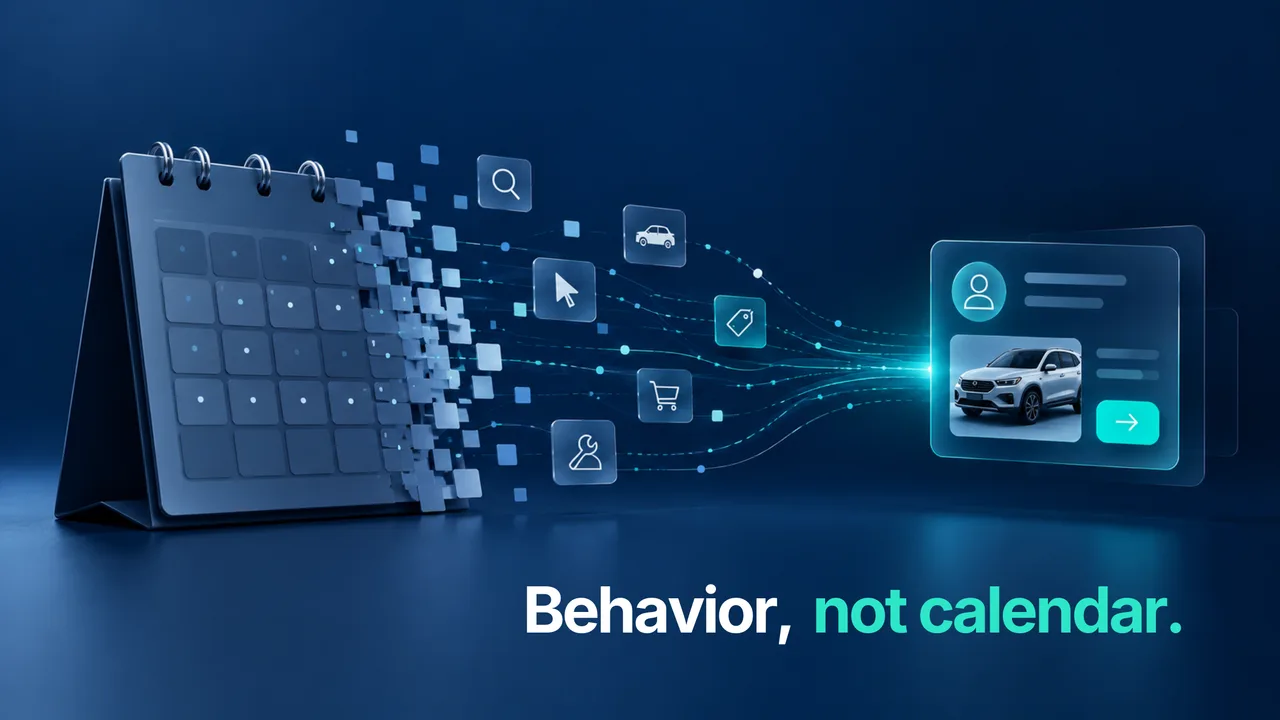
Behavior-triggered automotive marketing responds to customer signals as they happen, rather than waiting for the next campaign date.
What is behavior-triggered automotive marketing?
Behavior-triggered marketing uses customer actions and changing data to determine when marketing should start, change, or stop.
In automotive, those signals can include website visits, VDP activity, service history, purchase activity, lease maturity, equity position, ad engagement, and other customer or vehicle data.
Instead of asking what campaign are we sending this month, the better question becomes: what is this customer doing right now, and what should happen next?
The problem with calendar-based marketing
Campaign calendars aren't going away. Dealerships and OEMs will always have sales events, incentives, model launches, seasonal service promotions, and other planned campaigns.
The problem comes when the calendar becomes the only thing driving customer communication. A customer showing strong purchase intent today shouldn't necessarily have to wait until next month's campaign. And someone who bought yesterday shouldn't keep receiving acquisition messaging simply because the campaign is still running.
The campaign calendar should support the customer journey, not control it.
Customer behavior can change the journey
Imagine an existing customer who hasn't shown purchase intent recently. Then they return to the dealership website. They begin viewing SUV inventory and visit several VDPs. Their current vehicle may also be approaching a relevant ownership or equity milestone.
Those signals change what you know about that customer. They may now qualify for a higher-intent audience or a repurchase journey.
If they buy, the signals change again. Acquisition marketing can stop, and ownership, service, and retention communication can take over.
The customer changed. The marketing should too.
What can trigger automotive marketing?
A trigger doesn't have to be a lead submission. Useful signals can come from across the customer lifecycle.
A customer might view specific vehicle inventory, return to the website, engage with an ad, complete a service visit, approach lease maturity, reach a different equity position, or purchase a vehicle.
Each signal adds context. The important part isn't simply collecting the signal. It's using it to change what happens next.
A VDP view is more than a website visit
Vehicle Detail Page activity can be particularly useful because it provides context about what a shopper is interested in. Repeated visits to specific inventory or vehicle categories may indicate growing purchase intent.
When those behavioral signals are connected with existing customer and vehicle data, marketers can build a much clearer picture than they would from a lead form alone. The goal isn't to treat every VDP view as a buyer. It's to combine signals to better understand intent.
Triggers can start marketing and stop it
Behavior-triggered marketing isn't only about sending something. Suppression is just as important.
A purchase might remove someone from acquisition advertising. A service visit might stop a reminder that is no longer relevant. A customer responding to one offer may need to move into a different journey.
Sometimes the best next action is no action at all. This helps reduce wasted media and prevents customers from receiving communication that no longer makes sense.
Behavior can trigger more than email
Triggered marketing is often associated with email or SMS, but the same idea can work across channels. Depending on the customer and the signal, the next action could involve:
- Digital advertising
- Social
- SMS
- CTV
- Triggered direct mail
- Dealership outreach
A customer signal can change an audience, trigger a message, influence media activity, or start a personalized print piece. The channel comes after the decision. First understand what changed. Then determine what should happen next.
Where AI and predictive analytics fit
One signal rarely tells the whole story. A VDP visit alone doesn't mean someone is ready to buy. Neither does equity, service history, or an ad click. The value comes from understanding those signals together.
ClicMotion uses customer and vehicle data with predictive analytics to help identify purchase, service, churn, renewal, and repurchase opportunities as customer signals change. That makes it possible to prioritize customers based on what's happening now rather than relying only on static lists created at the beginning of a campaign.
Behavior-triggered marketing across the customer lifecycle
This approach isn't limited to vehicle sales.
- During acquisition, shopping behavior can signal increasing purchase intent.
- After purchase, the customer can move into ownership and service communication.
- During ownership, service activity and other customer signals can influence retention marketing.
- As lease maturity, equity, or new shopping activity appears, the customer may become a repurchase opportunity.
The same customer can move through all of these stages. Their marketing should move with them.
How ClicMotion supports behavior-triggered automotive marketing
ClicMotion connects customer, vehicle, and behavioral data so marketing can respond as customer intent changes.
Signals from the DMS, CRM, website and VDP activity, service history, inventory, paid media, offers, bureau data, and other sources can help build a current view of the customer. From there, audiences and journeys can change based on what happens next.
A shopper can move into a higher-intent audience. A service event can trigger communication. A customer showing repurchase signals can enter a new journey. A completed sale can stop acquisition activity.
And those actions can work across digital media, social, email, SMS, CTV, triggered print, and dealership outreach. The goal isn't more marketing. It's marketing that responds to the customer.
Behavior-triggered automotive marketing FAQs
What is behavior-triggered automotive marketing?
Behavior-triggered automotive marketing uses customer actions and changing data to determine when marketing should start, change, or stop.
What are examples of automotive marketing triggers?
Triggers can include website and VDP activity, ad engagement, service events, purchases, lease maturity, equity changes, and other customer or vehicle signals.
Is triggered marketing the same as marketing automation?
Not exactly. Marketing automation often follows predefined schedules or workflows. Triggered marketing uses customer events or changing signals to determine when an action should happen.
Can direct mail be triggered by customer behavior?
Yes. Direct mail can be triggered by customer data or events rather than sent only as a large batch campaign. This allows print to become part of a broader multi-channel customer journey.
Can a trigger stop a campaign?
Yes. A purchase, service event, or other change in customer status can be used to suppress or change marketing that is no longer relevant.
Do dealerships still need a marketing calendar?
Yes. Sales events, incentives, model launches, and seasonal campaigns still matter. Behavior-triggered marketing works around those campaigns so customer activity can influence what happens between scheduled marketing events.
Follow the customer, not just the calendar
Campaign calendars tell you when you planned to market. Customer behavior tells you when something has actually changed.
ClicMotion connects customer intelligence, behavioral signals, predictive analytics, and multi-channel activation so automotive marketing can respond to those changes.
The calendar still matters. The customer matters more.
Book a ClicMotion demo to see how behavior-triggered marketing can connect acquisition, service, retention, and repurchase.
Back to all articles