

How to Identify In-Market Car Buyers Before They Become Leads
A lead form tells you when someone contacted you, not when they started shopping. By then, many buyers have already compared vehicles, checked inventory, explored payments, and considered what their current vehicle is worth. An in-market buyer is someone actively moving toward a purchase, whether or not they have made an inquiry.
If your marketing waits for the form, you risk missing opportunities to influence that research. Here are the mistakes that keep marketers waiting, and what to do instead.
Shopping starts before the inquiry
A lead form shows when a buyer chose to contact you. It does not show when they started shopping.
Picture a shopper comparing two hybrid SUVs over several days. If your marketing only responds after an inquiry, that shopper gets nothing useful during the research. Another brand answers the ownership-cost question, makes suitable inventory easy to find, and earns the appointment. You might still get a lead later, but you missed the chance to influence which vehicles made the shortlist.
The better move is to respond to shopping evidence while the customer is still choosing, with information that helps them decide. That is a question of what each customer needs next, not of selling harder.
Same page, three different shoppers
Not every visit means the same thing. Three questions help. Is the activity recent? Is it specific, meaning comparing available vehicles and costs rather than reading general model information? And is it getting more focused across visits?
Take three customers who each own an older SUV and each visit the same hybrid SUV page. All three land in the same retargeting audience. They are not the same shopper. (These are illustrations of decisions, not fixed scoring rules.)
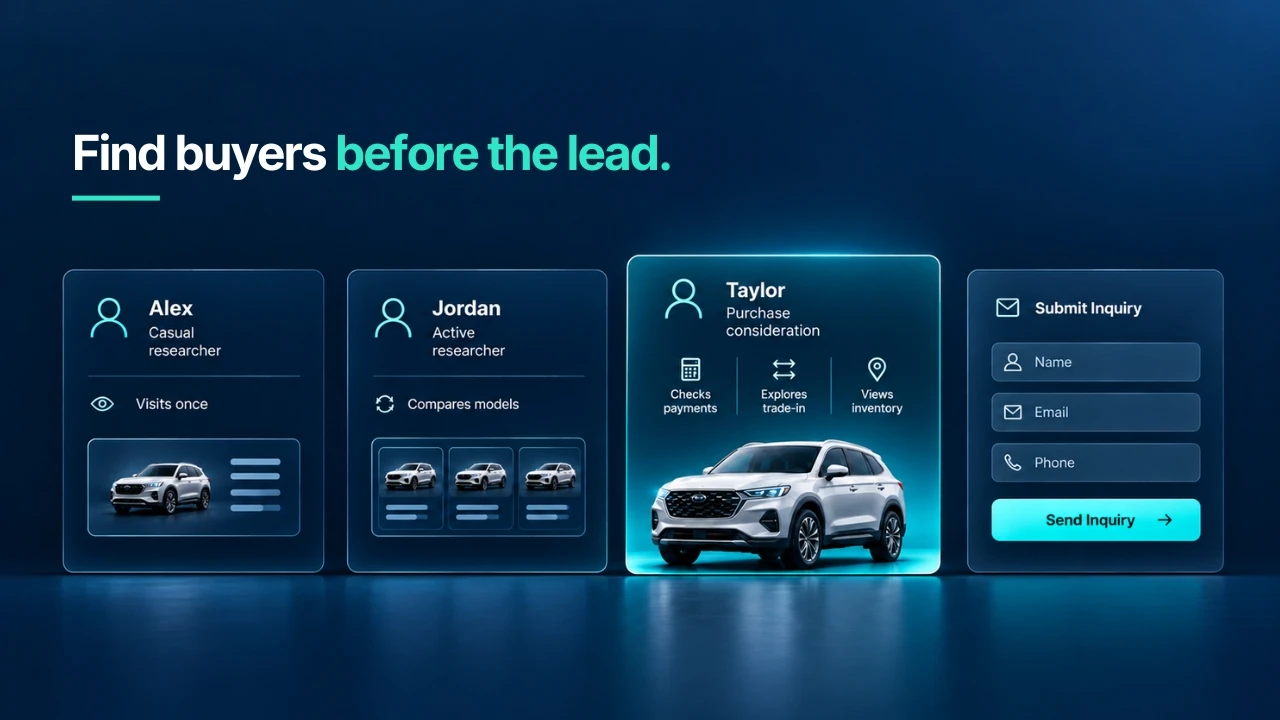
Alex visits once after clicking an ad. A model overview is a useful response. One visit is not a reason for repeated purchase offers.
Jordan returns over several days, comparing hybrids, features, and ownership costs, but has not chosen specific inventory. Help Jordan compare, and make the route to available vehicles clear.
Taylor keeps viewing specific available SUVs, explores payments, and uses a trade-in tool. Lead with matching inventory and an appraisal or appointment option, plus a relevant follow-up where contact permissions allow.
Ownership adds context, not intent. A lease ending soon or positive equity may explain why a change makes sense, but neither proves the customer wants one. Treat ownership as a second condition next to shopping activity, never a trigger on its own, and confirm equity figures before making any specific offer.
A visit gets someone into an audience. It does not tell you who will buy.
Retargeting lets you reach someone again. It does not tell you how likely they are to buy, and it only covers people who visited your website.
Predictive intelligence estimates which customers are most likely to buy within a defined period, using combinations of signals instead of a single rule. A purchase model learns from historical examples, and it can help you decide where to concentrate attention inside a retargeting audience. It can also surface existing owners who have not returned to your site, using other customer and vehicle signals.
A score is only as good as the question behind it, so ask three things. What does the model predict? Clicks, inquiries, and delivered vehicles are different outcomes. Over what period? And do higher-scoring customers actually buy at a higher rate than a simpler audience?
Predictive intelligence needs to earn its place through better decisions.
Measure the sale, not just the form
If leads and clicks are all you measure, you cannot tell whether earlier marketing changed anything. Choose the outcome before you launch, whether appointments, delivered vehicles, or qualifying renewals. Keep a similar group out of the new approach, a comparable holdout, so you can see what the extra marketing changed.
What that means depends on where you sit. An OEM can reach competing-brand owners researching a relevant segment and judge purchases across participating dealers. A dealer group can recognize a service customer at one rooftop researching replacements at another, and send one coordinated response. A captive finance company can combine lease timing with current research to separate active replacement consideration from a distant decision. An agency can spell out which signals justify different content or investment, then compare outcomes against the current approach.
Where to start
You do not need to rebuild your program. Take one audience you already pay to reach, and:
- Split it by evidence: one visit, repeat research, and specific inventory or payment activity.
- Name what stronger evidence would change: the inventory shown, the message, the investment, or the invitation to talk to someone.
- Pick the outcome before launch, and hold out a comparison group.
- Review as behavior changes. Move people down when research stops and up when it sharpens.
If everyone still gets the same treatment, collecting more signals has not improved the decision.
ClicMotion brings customer and vehicle information together with shopping signals, then uses predictive analytics to help prioritize purchase opportunities. Those insights inform audiences and marketing journeys, so the differences illustrated by Alex, Jordan, and Taylor can shape who you reach and what you say. As signals change, scoring and journeys can change too. That connects identifying an opportunity with acting on it before an inquiry arrives.
Your next buyer may already be researching. A lead form gives you an inquiry to answer. Earlier intelligence gives you a chance to become part of the choice that leads to it.
In-market car buyer FAQs
What is an in-market car buyer?
An in-market car buyer is someone actively moving toward a vehicle purchase, such as comparing models, checking inventory, or exploring payments. They may not have contacted a dealer yet.
Can you identify potential car buyers before they submit a lead?
Yes. Shopping activity combined with customer and vehicle information can show signs of purchase intent. Identifying a specific person requires reliable matching and permitted use of the available data.
What signals show someone is in the market for a vehicle?
Look for research that is recent, specific, and progressing. Repeat visits, views of specific available vehicles, and activity around payment or trade-in tools are stronger evidence than a single page view.
Does predictive intelligence replace retargeting?
No. It helps prioritize customers within retargeting audiences and informs how you communicate with them. It can also assess existing customers without a recent website visit.
How do you know predictive targeting adds value?
Compare purchase outcomes with a simpler audience over the same period, and use a controlled test where practical to see whether changing the marketing creates additional results.
Book a demo with ClicMotion to see how you can identify and target in-market buyers before they become leads.
Back to all articles