What is an automotive CDP?
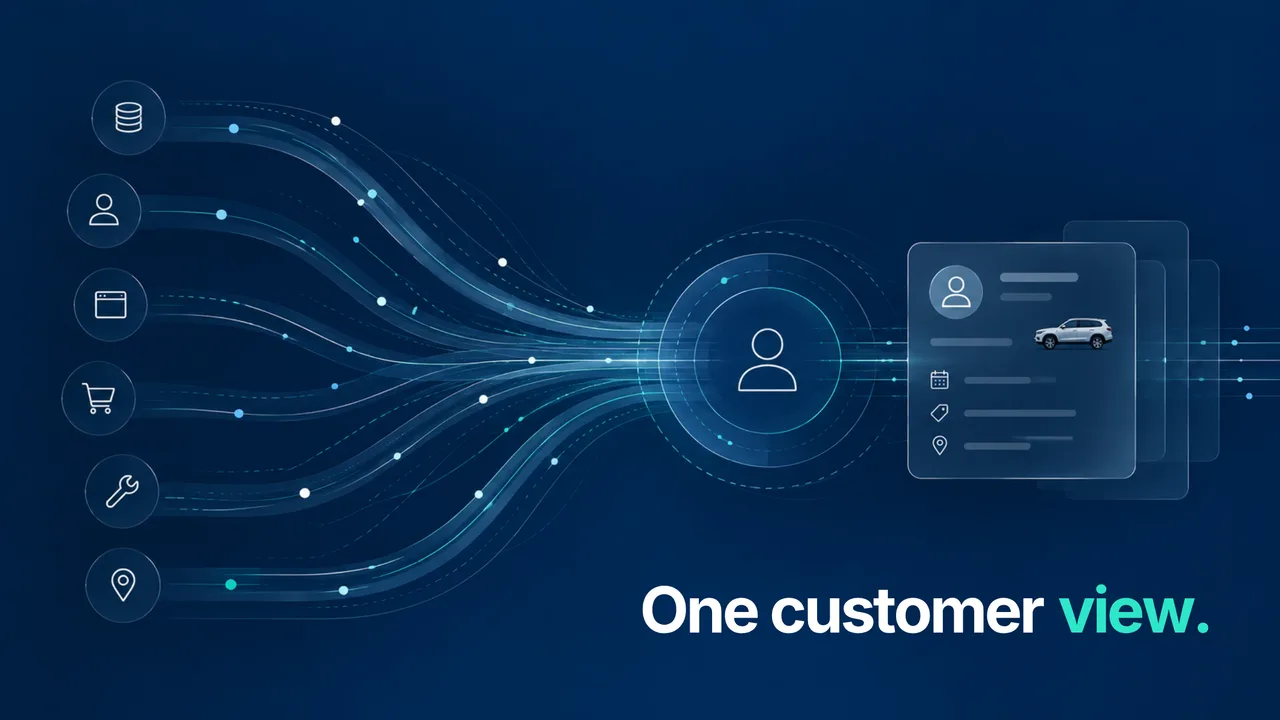
Your dealership already has customer data. Probably a lot of it. It sits across your DMS, CRM, website, service records, lead forms, advertising platforms, inventory systems, and third-party data sources. The challenge is not collecting more data. It is connecting it well enough to understand who the customer is, what they are doing, and what should happen next.
That's where an automotive Customer Data Platform, or CDP, comes in.
What is an automotive CDP?
An automotive CDP brings customer, vehicle, behavioral, and marketing data together to create a more complete view of each customer or household.
For example, the same person might exist as:
- A lead in the CRM
- A vehicle owner in the DMS
- A recent service customer
- An anonymous website visitor
- A shopper viewing specific VDPs
- Someone engaging with your advertising
A CDP helps connect those signals instead of treating them as separate customers.
But creating a unified profile is only the beginning. A CDP shouldn't just tell you who your customer is. It should help you decide what to do next.
What data does an automotive CDP use?
An automotive CDP can connect data from sources such as CRM and DMS records, sales and service history, website and VDP activity, inventory, lead forms, OEM and dealer offers, paid media, bureau data, and other in-market signals.
The result is a customer profile that can change as new information comes in. Someone who was a service customer yesterday could become an active shopper today. Someone researching a new SUV could purchase tomorrow. Their profile, audience, and marketing should be able to change with them.
How is a CDP different from a CRM or DMS?
A CRM helps dealerships manage leads and customer relationships. A DMS helps manage core dealership operations, transactions, vehicle, sales, and service data.
A CDP doesn't need to replace either one. Instead, it connects data from those systems with behavioral and marketing signals to create a broader view of the customer.
Think of the CRM and DMS as important sources of customer information. The CDP is the intelligence layer that helps make that information actionable across marketing.
From customer data to customer intelligence
Knowing that someone owns a vehicle is useful. Knowing that they own a vehicle, have positive equity, recently returned to your website, viewed three SUV VDPs, and engaged with an offer tells you much more.
That's the difference between storing customer data and using customer intelligence.
ClicMotion continuously brings together customer, household, vehicle, shopping, and marketing signals to identify opportunities across acquisition, service, retention, and repurchase.
Why behavioral and clickstream data matters
A customer record tells you what has happened. Behavior can tell you what may be happening right now.
Website visits, VDP views, inventory searches, ad engagement, and other digital activity can signal changing intent before a customer submits another lead. That matters because automotive shopping doesn't begin when someone fills out a form.
By connecting behavioral signals with known customer and vehicle data, marketers can identify high-intent audiences earlier and respond with more relevant messaging.
What does AI add to an automotive CDP?
AI becomes useful when it helps turn all that connected data into decisions. ClicMotion uses customer and vehicle signals to help identify purchase, service, churn, renewal, and repurchase opportunities.
Those signals can help determine: who should be prioritized? What should they receive? Which channel should be used? What should happen next?
And as new information comes in, those decisions can change. A prediction may identify someone as a likely buyer. An actual purchase should immediately change the journey.
A CDP should activate, not just organize
A unified customer profile isn't very useful if marketers still have to export lists and rebuild audiences across separate systems every time they want to act.
ClicMotion connects customer intelligence directly to activation across email, SMS, social, digital media, CTV, triggered direct mail, and dealership outreach.
That means a customer signal can do more than update a dashboard. It can change what happens next. A shopper showing increased intent might enter an acquisition audience. A purchase can stop those messages. A service event can trigger a different journey. A new shopping signal later can open a repurchase opportunity.
The data and the action stay connected.
Why triggered direct mail matters
Direct mail is often treated differently from digital marketing because it's traditionally planned and sent in large batches. It doesn't have to work that way.
With the right customer intelligence behind it, print can become another triggered channel within the customer journey. A specific customer event or change in eligibility can trigger a relevant mail piece, just as it might trigger an email, digital audience, or dealership follow-up.
That makes print part of the multi-channel strategy instead of a separate campaign calendar.
Closing the loop with measurement
Activation is only part of the job. An automotive CDP should also help connect marketing activity to customer outcomes.
ClicMotion can match customer outcomes back to the marketing and advertising channels involved, helping marketers understand what's driving engagement and conversion and make better decisions about future investment.
Those outcomes then become new customer signals.
Connect → Understand → Predict → Act → Measure → Learn
That's what turns a database into an always-on marketing engine.
What should you look for in an automotive CDP?
A useful automotive CDP should do more than unify records. It should be able to connect customer and vehicle data, resolve identities and households, incorporate behavioral signals, identify intent, build and refresh audiences, activate across channels, measure outcomes, and use those outcomes to improve what happens next.
Most importantly, it should understand the automotive customer lifecycle. Because buying a vehicle isn't the end of the customer journey. It's the beginning of the next stage.
Automotive CDP FAQs
What does CDP stand for in automotive marketing?
CDP stands for Customer Data Platform. It connects customer data from multiple sources to create a unified customer profile that can be used for marketing, analytics, personalization, and audience activation.
What is the difference between a CDP and CRM for a dealership?
A CRM primarily helps dealerships manage leads and customer relationships. A CDP connects CRM data with DMS, service, website, vehicle, behavioral, advertising, and other data to build a broader customer view and make it actionable across marketing.
Does an automotive CDP replace a DMS?
No. A CDP works with DMS data rather than replacing the DMS. It connects that information with other customer and marketing signals.
What data can an automotive CDP connect?
Depending on the platform and available integrations, an automotive CDP can use CRM, DMS, sales, service, website, VDP, inventory, advertising, OEM, offer, bureau, and third-party data.
Can an automotive CDP identify customers before they submit a lead?
Behavioral and first-party data can help identify or prioritize shopping activity before a new lead form is submitted when that activity can be connected to a known customer or household.
What can dealerships do with a CDP?
Dealerships can use a CDP to build better audiences, identify high-intent shoppers, improve service retention, personalize communication, coordinate marketing across channels, identify repurchase opportunities, and measure customer outcomes.
From customer data to customer action
The value of an automotive CDP isn't simply having all your data in one place. It's being able to do something useful with it.
ClicMotion connects customer and vehicle data with behavioral signals, AI-driven decisioning, multi-channel activation, and measurement across the automotive customer journey.
Know the customer. Understand the moment. Make the next move.
Book a ClicMotion demo to see how your customer data can become an always-on acquisition and retention program.
Back to all articles